Thursday, March 6, 2014

Jesus and Deliverance Ministry

The Passage
Matthew 8:14-15; Matthew 4:23-25; Mark 1:29-39; Luke 4:38-44[1] 
When the sun was setting, all those who had any that were sick with various diseases brought them to Him; And the whole city was gathered together at the door. He laid His hands on every one of them and healed them, that it might be fulfilled which was spoken by Isaiah the prophet, saying: ​​“He Himself took our infirmities and bore our sicknesses.”[2]
​​                And demons also came out of many, crying out and saying, “You are the Christ, the Son of God!” And He, rebuking them, did not allow them to speak, for they knew that He was the Christ.
Now in the morning, having risen a long while before daylight, He went out and departed to a solitary place; and there He prayed. And Simon and those who were with Him searched for Him. When they found Him, they said to Him, “Everyone is looking for You.”
But He said to them, "I must preach the kingdom of God to the other cities also, because for this purpose I have come forth.” And He was preaching in their synagogues throughout all Galilee, and casting out demons.
Then His fame went throughout all Syria; and they brought to Him all sick people who were afflicted with various diseases and torments, and those who were demon-possessed, epileptics, and paralytics; and He healed them. Great multitudes followed Him—from Galilee, and from Decapolis, Jerusalem, Judea, and beyond the Jordan.

A Little Background
In New Testament times, day and night was reckoned at 6:00 a.m. and 6:00 p.m. So the Sabbath began at sundown on Friday through sundown Saturday. Likewise, when Scripture references the third hour of the day, for example, it means 9:00 a.m., not 3:00 a.m.

Some Explanation
According to Jewish law, any kind of healing was forbidden on the Sabbath (it was considered work). So the people waited until nightfall. Since “the whole city” came to Jesus’ door with all kinds of sicknesses and afflictions, Jesus would have been actively ministering late into the night. Still, he arose while it was still dark to get alone to pray.

Observations and Insights
Earlier when Jesus was at the synagogue, a man with a demonic (unclean) spirit called out to Him, “I know who You are—the Holy One of God!” Jesus rebuked him and told him to be silent, and then cast him out.

Many years ago in some factions of the church, deliverance ministry was a hot trend. Books were written and classes taught on how to cast out demonic spirits. It seemed that a spirit was behind every sin and character flaw. These teachings were derived by those who had learned important information about the spiritual world by engaging with these demons.

Unlike modern spiritual warfare, Jesus did not allow the demons to speak “for they knew that He was the Christ”. First, I find it interesting that although the Jews didn’t recognize their Messiah, the demons certainly knew who He was. Secondly, James 2:19 tells us about demons, “You believe that there is one God. You do well. Even the demons believe—and tremble!” Demons most surely believe in God—for they followed their leader, Lucifer, and were cast out of Heaven by God Himself! Yet, their belief is obviously not one of faith unto worship. Jesus did not allow the demons to speak because demons are lying spirits. He did not need their testimony about Him, nor their dramatic showmanship.

A common complaint about some Bible teaching is that it needs to be relevant. So, at the risk of beating a dead horse I want to make a relevant point. Recently a television series and a movie on the Bible and the life of Jesus Christ have been promoted even by Christian ministries as being a valuable tool for witnessing. Many Christians argue that it is good, clean programing, and that it can get people talking and interested in reading the Bible.  Since the producer of the film is an avowed New Ager, I wonder, based on this Scripture, if Jesus would agree?

This incident also reminds me of a time when the apostle Paul was in Philippi[3]. As he and Silas ministered, a servant girl followed them proclaiming, “These men are the servants of the Most High God, who proclaim to us the way of salvation.” For a few days, they ignored her. Her words, in and of themselves, were certainly true, but she was possessed by a demonic spirit. Paul was right to cast out the spirit. Why?—Because Satan is the father of lies. He never has, nor never shall be a source for truth, and most assuredly, anything that comes from the kingdom of darkness will be twisted and lead followers away from the true Lord Jesus Christ, not to Him. Even logically, it can be no other way.

Deliverance was certainly a part of Jesus’ earthly ministry. I have no doubt that demonic activity is just as prevalent today as it was in Jesus’ day. It is not the scope of this blog to expound on exorcism/deliverance ministry, or the difference between demonic possession or oppression and how it relates to Christians. I do know that I can give Satan a foothold or place to act in my life by my anger (Ephesians 4:29). And we are not to fellowship with the works of darkness, but rather expose them, for it is a shame even to speak of them. (Eph. 5:11-14—Would this also apply to popular fiction and entertainment?) I also know that when it comes to supposed demonic activity, I’ve seen a lot of hullabaloo.

Regardless of any popular teaching on this issue, Jesus clearly did not allow demons to have any limelight. Jesus Himself is the Truth. And the truth is that according to Colossians 1:13-23, I am delivered out of the kingdom of darkness into the kingdom of the Lord Jesus Christ when I receive His redemption and forgiveness of sins through His blood atonement on the cross. That is the message of hope. That is the central message of the Kingdom.

Next:    Matthew 8:1-4; Mark 1:40-45: Luke 5:12-16


[1] Note: Much of the Harmony readings will be pieced together like a puzzle putting the four Gospels together into one narrative. I am copying the order or format from A Simplified Harmony of the Gospels, George W. Wright, Holman Bible Publishers, 2001. However, I am using the New King James rather than the HCSB. This order is from the research of Wright and is open to discussion. Of course, you can also read the passages side by side separately if you prefer.
[2] Isaiah 53:4
[3] Acts 16:16-18


Monday, March 3, 2014

They Were Astonished at His Teaching

The Passage
Mark 1:21-31; Luke 4:31-39[1]
Then they went into Capernaum, and immediately on the Sabbath He entered the synagogue and taught. Now there was a man in their synagogue with an unclean [demon Luke 4:33] spirit. And he cried out, saying, “Let us alone! What have we to do with You, Jesus of Nazareth? Did You come to destroy us? I know who You are—the Holy One of God!”
                 But Jesus rebuked him, saying, “Be quiet, and come out of him!” And when the unclean spirit had convulsed him and cried out with a loud voice, he came out of him.
                 And they were astonished at His teaching, for He taught them as one having authority, and not as the scribes. Then they were all amazed, so that they questioned among themselves, saying, “What is this? What new doctrine is this? For with authority He commands even the unclean spirits, and they obey Him.” And immediately His fame spread throughout all the region around Galilee.
Now as soon as they had come out of the synagogue, they entered the house of Simon and Andrew, with James and John. But Simon’s wife’s mother lay sick with a fever, and they told Him about her at once. So He came and took her by the hand and lifted her up, and immediately the fever left her. And she served them.

A Little Background
Capernaum is a small seaside town on the northern shore of the Sea of Galilee. It was known for its thriving fishing trade. After Jesus’ rejection in Nazareth, He went to Capernaum. This is where Jesus spent the first two years as His base of ministry. There were times that He went back to Jerusalem and ministered in other areas, but Capernaum was home.

Some Explanation
And they were astonished at His teaching, for He taught them as one having authority, and not as the scribes... The Scribes were the copiers of the law. Pharisees were interpreters and teachers of the Law. (For an explanation of the rise of the Scribes and Pharisees, clickhere.) They focused not only on the written law known as the Torah (Genesis-Deuteronomy), but they also added the “oral law”. These oral laws were oppressive.

The purpose of God’s law was to show His holiness and our complete and utter inability to attain it. Galatians 3:23-25 calls it a school master or tutor. When we see our utter depravity by the magnitude of the law, we have no other option than to cry for mercy. God’s mercy is the Lord Jesus Christ Himself who stood in our place. He kept the law and offered Himself as a perfect sacrifice for sin—the Lamb of God who takes away the sin of the world. Salvation comes to us when we believe in Jesus’ cross-work that for us.

The Pharisees’ Judaism trusted only the law. If they could keep the written law, (which they really couldn’t) then they could “one-up” and do even better. If it was against the law to “work” on the Sabbath, then that meant carrying a load was work, so it was against the law to carry a load on the Sabbath, they concluded by their reasoning. If carrying a load was work, then carrying anything was work...and so forth... In creating these “one-up” laws they depended on the writings of esteemed teachers which they quoted generously. When Jews went to synagogue to hear the Scriptures read, they also listened to the additional teachings of these various interpretations and additions.

Jesus had been teaching throughout Galilee so when He came to the synagogue He was invited to read the Scriptures as an esteemed guest. But when He began to teach, it was obvious that His teaching was different from that of the Scribes.

Observations and Insights
These Galilean Jews were astonished and amazed by Jesus’ teaching and authority. Why was that? We have the benefit of the answer in John 1:1-14. Jesus is the very Word of God made flesh. He was the embodiment of the very Word He is speaking.

In this passage we see that Jesus showed authority in casting out a demon, in how He taught, and in healing Peter’s mother-in-law. He had the right to speak. He had boldness in how He taught, and He had power by His speech to cast out the demon and heal. Jesus’ authority was unlike anything that these Jews had seen or heard.

When I read this passage, I connected with these Galileans who had heard all the rules on how to “do it right”. I think of the many books, CD teachings, seminars and conferences that I’ve been to over the years. Many of us have libraries full of every new teaching under the sun. Most of them have taught me that I need to use certain phrases when praying. I need to be trained in a particular process for ministry. And of course I need to pay a fee for the privilege. In some cases I’ve watched other sheep pour over their notes so that they “get it right”. I’ve tried some of it over the years. I tried to lead ministry and remember all the principles when faced with challenges. So when things don’t work out like they’re supposed to, I beat myself up for “getting it wrong”. I didn’t pray it right; I didn’t “hear” it right; I didn’t do it right. Feels Pharisaical to me.

I’ve been to dozens, perhaps hundreds of churches in my life of ministry. Libraries are filled with books on how to have a deeper life, how to have a better marriage, how to do deliverance ministry, how to do inner healing, how to declare my victory, how to live in the Spirit.... Trends, leaders and experts will all pass away, but God’s Word remains forever. Now that’s authority. I love it. I desire to live it. I’m setting my face toward it. It’s all that I’ll ever need. 

Next:    Matthew 8:14-15; Matthew 4:23-25; Mark 129-39; Luke 4:38-44


[1] Note: Much of the Harmony readings will be pieced together like a puzzle putting the four Gospels together into one narrative. I am copying the order or format from A Simplified Harmony of the Gospels, George W. Wright, Holman Bible Publishers, 2001. However, I am using the New King James rather than the HCSB. This order is from the research of Wright and is open to discussion. Of course, you can also read the passages side by side separately if you prefer.

Thursday, February 27, 2014

The Son of God Movie BOLO

I clicked on the movie trailer for the upcoming opening of the Son of God movie and discovered that it opens with Peter fishing. How timely! Our next reading is Matthew 4:18-22; Mark 1:16-20; Luke 5:1-11.[1]
So it was, as the multitude pressed about Him to hear the word of God, that He stood by the Lake of Gennesaret[2], and saw two boats standing by the lake; but the fishermen had gone from them and were washing their nets. Then He got into one of the boats, which was Simon’s, and asked him to put out a little from the land. And He sat down and taught the multitudes from the boat.
When He had stopped speaking, He said to Simon, “Launch out into the deep and let down your nets for a catch.”
But Simon answered and said to Him, “Master, we have toiled all night and caught nothing; nevertheless at Your word I will let down the net.” And when they had done this, they caught a great number of fish, and their net was breaking. So they signaled to their partners in the other boat to come and help them. And they came and filled both the boats, so that they began to sink.
When Simon Peter saw it, he fell down at Jesus’ knees, saying, “Depart from me, for I am a sinful man, O Lord!” For he and all who were with him were astonished at the catch of fish which they had taken; and so also were James and John, the sons of Zebedee, who were partners with Simon.
And Jesus said to Simon, “Do not be afraid. From now on you will catch men.” So when they had brought their boats to land, they forsook all and followed Him.

Ever since The Exodus, Ben Hur, and The Robe, Christians have delighted in seeing their faith depicted on Hollywood’s silver screen. We have learned to be tolerant of “minor” changes in detail. We understand that certain “artistic license” is necessary in a movie, to move the action forward, we’re told.

Now that I am reading the gospels in harmony, I’ve known a greater depth of love for the Lord Jesus, His atoning sacrifice for me, and the joy of following Him as my Shepherd. So, I want to know will this movie benefit my walk with the Lord?  Philippians 1:9-11 tells us that our love should abound in knowledge and judgment [discernment, depth of insight] so that we can approve things that are excellent and be filled with fruits of righteousness for God’s glory and praise. So let’s exercise our spiritual muscles. First we’ll compare the movie clip to Scripture to see how it lines up and if the differences are significant. Then we’ll see if we can approve it as excellent by applying knowledge and some discernment.  Will The Son of God movie fill us with fruits of righteousness for God’s glory and praise?

How does it line up with Scripture?


Knowledge
Focus on the Family’s Jim Daly, Liberty University, Women of Faith, and Joel Osteen have all endorsed and promoted the movie. They have embraced the producers, Roma Downey and her husband Mark Burnette as fellow Christians. So, we can trust these leaders and know that the film is a trustworthy resource for Biblical truth, right? Well, in Galatians 1:8, 9 Paul said that even if he himself or an angel from heaven preached any other gospel, let him be accursed [be condemned to Hell]. That’s some extremely stiff wording. Paul also commended the Bereans for comparing his preaching to the Scriptures. So for me, I’m going to do some research and see if the movie comes from a trustworthy source.

I cannot and will not judge Downey and Burnette’s salvation; that is only for God to do. However, the Bible says to test all things; therefore, I must test or judge what they say they believe in. If their beliefs are not Christian, then I cannot promote them as Christian. Ms. Downey has recently graduated with a master’s degree in Spiritual Psychology[3] from the University of Santa Monica[4]. Her degree may sound like a Christian version of psychology from a major university, but neither of these assumptions is true. The University of Santa Monica exists for only one degree. What is Spiritual Psychology? It is specifically the study of spiritual evolution. The true agenda behind evolution is not just the origin of the universe. Ultimately we are not finished evolving; mankind will evolve to godhood or spiritual oneness with the universe. This is done by self-realization. Both USM and the degree are pure New Age.

Many people see the New Age as simply a religious system in which people combine religions, burn incense, do yoga and worship crystals. But NA philosophy is far more insidious. The scope of understanding NA is not the point of this post, but in summary, the NA has an agenda to infiltrate all aspects of life— church, government, home, education, etc. to bring all into a state of one universal consciousness to save the planet. Doing so will usher in a new age of enlightenment—a new world order. Self-realization is accomplished through meditative, altered-states of consciousness. This is Ms. Downey’s area of expertise. She claims, “My husband says I’m so self-realized I’m practically levitating.”[5]

The Bible says that we are all gone out of the way; we are separated from God by our sin. The only way to reconciliation with Him is through faith in the blood sacrifice of Jesus Christ because He bore the wrath of God on our behalf. Faith in His atonement is the way of salvation. The New Age uses Christian vocabulary, but with very different definitions. In the NA, Jesus and Christ are two different entities. “Christ” hood is to be self-actualized or self-realized. Jesus was “a Christ”. So were Buddha and others. The only “sin” is refusing to join in global oneness. In fact, very powerful and influential NA leaders claim that ultimately, those who refuse to join in oneness must be eliminated. Ms. Downey has joined these leaders by co-endorsing books teaching self-realization.[6]

And one more interesting item—Ms. Downey has appeared on psychic medium John Edward’s show in which he contacted her dead mother with her[7]. Clearly, whatever Ms. Downey’s spiritual standing before God may be, the philosophy she endorses by her own actions and words is explicitly NOT Christian.

Discernment
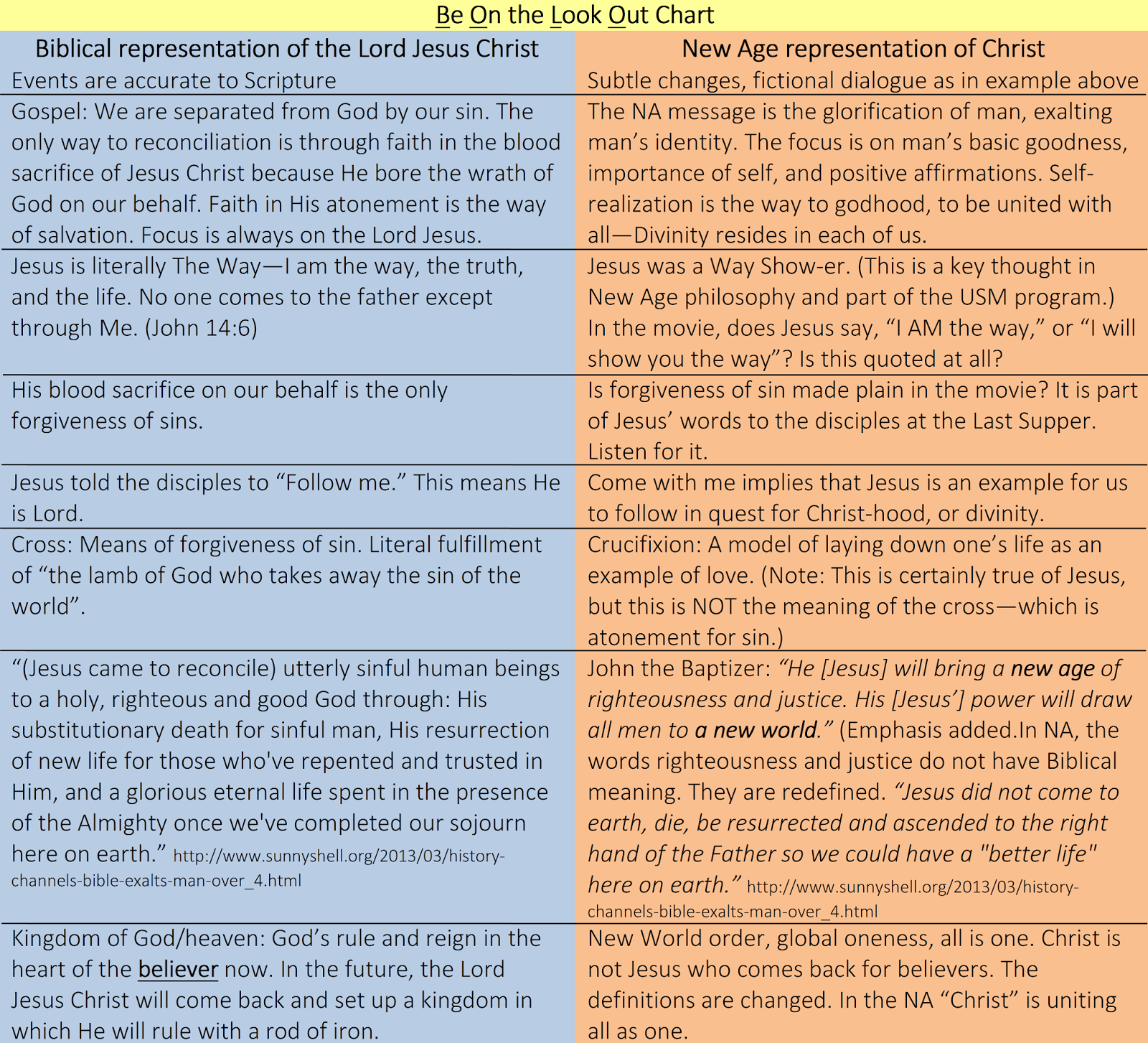
Popular law enforcement TV shows talk about issuing BOLO’s—Be On the Look Out. The point of this blog post is not to tell my readers not to see the movie. I will not think any less of anyone who does. However, we absolutely MUST, by scriptural command, test all things, and discern (1 John 4:1; Phil. 1:9-ll). So I am issuing a BOLO for those who choose to go to The Son of God movie. Does the movie show the life of the Lord Jesus Christ from a Scriptural perspective or from a New Age perspective?  Here are some things to watch for: 


Summary
Some may see my analysis here as being too petty; the issues are not that big a deal. The New Age movement has been saying for years that subtle shifts will happen. I have seen these subtle shifts from truth being accepted and adopted throughout the “church”.  These shifts are known as the Dialectic Process. This process is an occult-based way to turn opposites into unity. In other words, light becomes dark and right becomes wrong. Subtle shifts in meaning change definitions. And wasn’t Satan subtle and positive with Eve? “Didn’t God say?...You surely will not die...” He has had millennia to hone is lying craft.

I understand that my view may be seen as negative, close-minded, fundamentalist, and hyper-critical. I have a confession to make. I have been positive, open-minded, progressive and accepting for many years. I have seen the Gospel of salvation traded to a gospel of morality and self-righteous works. I have heard the truths of Scripture preached less and less, while mega churches increase more and more. The more that I read the Scriptures, the more zealous I have become for truth. I am repenting for my part in a watered-down Gospel.

Galatians 4:4 tells us that in the fullness of time, God sent Jesus into the world. He didn’t send Jesus to us in an age of technical advancement when He could have had His life digitally recorded. God gave us the record of Jesus in an infallible, inerrant book we know as the Bible. It is a living Word that is powerful enough all by itself to pierce my heart and discern my thoughts[8]. That Bible tells me that there is “another Gospel”[9] and “another Jesus”[10], and that Satan disguises himself as an angel of light[11]. The Bible tells us that there will be a great deception in the last days. Many false christs will appear and deceive many. They will be able to perform all kinds of lying wonders[12] to deceive even the very elect[13]. Wolves will come in, not sparing the flock[14]. There will be a great departure from the faith[15] because those who seemed to be Christians[16] will follow deceiving spirits and doctrines of demons,[17]  and they will not endure sound doctrine[18]. False prophets will come into the church and bring destructive heresies even denying the Lord who bought them.[19]

Whether Christians go to see The Son of God is not the issue to me. What is absolutely vital is that we
as sheep learn to discern what is from our Shepherd and what is from wolves. As I stand here in the Shepherd's fold, the grass that Roma Downey is eating from may look lush and sweet, but it is deadly poisonous. Her teachers are ravenous wolves which will devour the sheep who go to her pasture. But maybe some who don’t know God will be turned to Him; maybe they’ll start to read their Bibles. Certainly God can work in any way that He chooses, but I am not aware of any time that God led a person to Satan as a resource to discover truth. New Agers read the Bible, too, and they twist and pervert it. What if the Jesus that they think they are receiving turns out to be “another one”?

BUT I know- that I know-that I know the Shepherd’s pasture in the Word has sweet nutritious green grass. His waters are still and refreshing. I will have my soul restored by Him again and again. He has promised that goodness and mercy shall be my companions and that I will dwell in His house forever. Hmm...Come to think of it, I’m getting hungry...


[1] Note: Much of the Harmony readings will be pieced together like a puzzle putting the four Gospels together into one narrative. I am copying the order or format from A Simplified Harmony of the Gospels, George W. Wright, Holman Bible Publishers, 2001. However, I am using the New King James rather than the HCSB. This order is from the research of Wright and is open to discussion. Of course, you can also read the passages side by side separately if you prefer.
[2] Also known as the Sea of Galilee
[3] http://www.universityofsantamonica.edu/About_USM/index.aspx
[4] http://www.universityofsantamonica.edu/index.aspx
[5] http://becksmithhollywood.com/2009/04/roma-downey-happy-out-of-spotlight/
[6] Barbara Marx Hubbard, one-time US vice-presidential nominee, is still very influential in politics. She wrote a booklet stating that though it will be painful, ¼ of the world’s population will reject oneness and will need to be eliminated. Both Downey and Hubbard have co-endorsed Loyalty to Your Soul, by Ron and Mary Hulnick, Executive faculty of USM. The authors state that Divine Essence [Ed. literally godhood] is the sacred reality of all creation. Downey says that this book is a reminder of all that she learned at USM. See: http://www.lighthousetrailsresearch.com/blog/?p=14764  
[7] http://www.john-roger.org/
[8] Hebrews 4:12
[9] Galatians 1:8,9
[10] 2 Corinthians 11:4
[11] 2 Corinthians 11:14
[12] 2 Thess. 2:9, 10
[13] Matt 24:5
[14] Acts 20:28-30
[15] 2 Thess. 2:3
[16] Note: a “falling away” means apostasy. Unbelievers do not “fall away” from the faith because they never had it to begin with.
[17] 1 Tim. 4:1
[18] 2 Tim 4:3
[19] 2 Peter 2:1-3

Monday, February 24, 2014

A Homecoming—Rejection

The Passage
Matthew 4:13-16; Luke 4:16-30[1]
          So He came to Nazareth, where He had been brought up. And as His custom was, He went into the synagogue on the Sabbath day, and stood up to read. And He was handed the book of the prophet Isaiah. And when He had opened the book, He found the place where it was written:​
​“The Spirit of the LORD is upon Me,
​​Because He has anointed Me
​​To preach the gospel to the poor;
​​He has sent Me to heal the brokenhearted,
​​To proclaim liberty to the captives
​​And recovery of sight to the blind,
​​To set at liberty those who are oppressed;
​​To proclaim the acceptable year of the LORD.”
Then He closed the book, and gave it back to the attendant and sat down. And the eyes of all who were in the synagogue were fixed on Him. And He began to say to them, “Today this Scripture is fulfilled in your hearing.”​
So all bore witness to Him, and marveled at the gracious words which proceeded out of His mouth. And they said, “Is this not Joseph’s son?”
He said to them, “You will surely say this proverb to Me, ‘Physician, heal yourself! Whatever we have heard done in Capernaum, do also here in Your country.’ ”
Then He said, “Assuredly, I say to you, no prophet is accepted in his own country. But I tell you truly, many widows were in Israel in the days of Elijah, when the heaven was shut up three years and six months, and there was a great famine throughout all the land; but to none of them was Elijah sent except to Zarephath, in the region of Sidon, to a woman who was a widow. And many lepers were in Israel in the time of Elisha the prophet, and none of them was cleansed except Naaman the Syrian.”
So all those in the synagogue, when they heard these things, were filled with wrath, and rose up and thrust Him out of the city; and they led Him to the brow of the hill on which their city was built, that they might throw Him down over the cliff. Then passing through the midst of them, He went His way.
And leaving Nazareth, He came and dwelt in Capernaum, which is by the sea, in the regions of Zebulun and Naphtali, that it might be fulfilled which was spoken by Isaiah the prophet, saying:​
​“The land of Zebulun and the land of Naphtali,
​​By the way of the sea, beyond the Jordan,
​​Galilee of the Gentiles:
​​The people who sat in darkness have seen a great light,
​​And upon those who sat in the region and shadow of death
​​Light has dawned.”

A Little Background
Elijah and Elisha were both prophets who ministered in the northern kingdom (Israel) of a split nation. Israel had no kings who followed God. Because Jereboam had divided the nation and set up his own worship system, the Israelites were given over to false worship and idolatry. Their act of leaving the faith is called apostasy. In each of these situations, the miracle performed by the prophets was for the benefit of pagans who were not Israelites, God’s chosen people.

The frenzied anger of the Nazarenes[2] was extreme. By taking Jesus to the edge of the cliff, they were preparing to stone Him. The first step was to throw the victim over the cliff. Next they would have thrown huge rocks at him with the intent to crack his skull until it split open and the brains gushed out. But it was not yet Jesus’ time to die. He miraculously slipped through the angry mob.

The second quote is from Isaiah 9:1, again prophesying about the reach of Messiah’s ministry. Zebulon and Naphtali were two of Jacob’s sons, and thus the names of two tribes of Israel. Their lots of land were on the far northern border of Israel. When the Jews returned from exile in Babylon, the people that settled in these regions soon mixed with the Gentile nations bordering them. In contrast to the Samaritans who also mixed with pagans, these mixed-race Jews adopted Judaism more for political purposes than religious. A people religiously Jewish would be loyal to Israel.  Jesus would go to these Jews who lived beyond Judea to light their way to His salvation.

Some Explanation
When Jesus was born, an angel told Joseph in a dream to leave Israel and take the family to Egypt to escape Herod’s murderous reach. Later, an angel again appeared to Joseph when Herod the Great was dead. But as they traveled back (apparently to settle near Jerusalem), Joseph heard that Herod’s son (Archelaus) had taken his place so Joseph took the family to the obscure little town of Nazareth. This put plenty of distance between the family and Herod. It would have been to their advantage not to tell the stories of Jesus’ birth. Would Jesus have done miracles as a boy? Not likely; why draw unnecessary attention? No doubt Jesus grew up like every other boy in Nazareth. And wasn’t that part of His purpose—to grow up experiencing life just as we all do without miraculous advantages?

Still, the shepherds told of their experience seeing and hearing the angels that wonder-filled night: “Now when they had seen Him, they made widely known the saying which was told them concerning this Child. And all those who heard it marveled at those things which were told them by the shepherds. ...Then the shepherds returned, glorifying and praising God for all the things that they had heard and seen, as it was told them.” (Luke 2:17-20)  Anna had also spread the word about who the baby was. (Luke 2:38) Surely these rumors were still floating around and would have easily confirmed the fishermen’s stories from Capernaum who had met the Messiah while following John.

“‘Physician, heal yourself! Whatever we have heard done in Capernaum, do also here in Your country.’” Now the people of Nazareth were hearing that this same Jesus who had grown up in their village was preaching, healing, and performing many signs and wonders in Jerusalem and nearby Galilee. Why didn’t He come to His own people if all the hype were true?

Observations and Insights
At first the response of the people at the synagogue was to marvel at Jesus’ gracious words until they realized, “Hey, isn’t this just the carpenter’s son we’ve always known?” Who did He think He was making the claim that He was the fulfilment of Messianic prophecies? He wasn’t doing any miracles for them. He should prove Himself to them.

When Jesus read their hearts’ motive, His response enraged them even more. He hit a nerve. How dare He suggest that uncircumcised pagans were more deserving of miracles than they were! The Nazerenes did not respond to Jesus in faith, but in doubt. And their pride was wounded. The issue was really about them

Oh, how this passage hits home with me, too! I am pained to admit how often I’ve felt jealousy at another’s testimony. Someone else had a prayer answered when mine are not. Another person shares some blessing that I have not known. Regardless of the others’ circumstances, my first heart response often puts me into a tailspin. Why doesn’t that happen to me? Does God really care? Suddenly the issue is about me, and my wicked heart is revealed. In some cases, I’ve sat in that sewage for many years. How ironic that I choose the bondage of self-pity when my Jubilee has set me free!

Then, in His sovereign faithfulness, God often brings a trial into my life to show me the depravity of my heart. I need this favor of His grace. If I could only learn to see my heavenly Father’s loving discipline to focus my heart’s attention back to Jesus. Instead, I reject Him, and there’s the rub. Oh, sure, I’ve put on my Christian happy face and say all the right words. I even learned how to pray the “right” words, and gin up faith for “my miracle”. It’s a lovely mask to hide my jealous heart.

He came to His own and His own did not receive Him, John 1:11 tells us. Jesus put on human flesh, but mankind rejects Him; the Jews reject Him; the Nazerenes rejected Him. Sometimes, I still reject Him. It has taken me too long to learn this lesson, but I am brought to tears when I think of all the “no’s” God has blessed me with. How thankful I am that God does not always give me the things I want.

Jesus is my Jubilee. May I trust Him more and love Him more until the day I see Him face to face.

Next reading: Matthew 4:18-22; Mark 1:16-20; Luke 5:1-11


[1] Note:  Much of the Harmony readings will be pieced together like a puzzle putting the four Gospels together into one narrative.  I am copying the order or format from A Simplified Harmony of the Gospels, George W. Wright, Holman Bible Publishers, 2001.  However, I am using the New King James rather than the HCSB.  This order is from the research of Wright and is open to discussion.  Of course, you can also read the passages side by side separately if you prefer.
[2] Not to be confused with “Nazirites”. A “Nazirite” was not associated with any town, but was a person who took a particular vow as described in Numbers 6. The vow and the town have nothing to do with one another.

Friday, February 21, 2014

A Homecoming—Jubilee


We’ll be taking two posts on the next passage.
The Passage
Matthew 4:13-16; Luke 4:16-30[1]
          So He came to Nazareth, where He had been brought up. And as His custom was, He went into the synagogue on the Sabbath day, and stood up to read. And He was handed the book of the prophet Isaiah. And when He had opened the book, He found the place where it was written:​
​“The Spirit of the LORD is upon Me,
​​Because He has anointed Me
​​To preach the gospel to the poor;
​​He has sent Me to heal the brokenhearted,
​​To proclaim liberty to the captives
​​And recovery of sight to the blind,
​​To set at liberty those who are oppressed;
​​To proclaim the acceptable year of the LORD.”
Then He closed the book, and gave it back to the attendant and sat down. And the eyes of all who were in the synagogue were fixed on Him. And He began to say to them, “Today this Scripture is fulfilled in your hearing.”​
So all bore witness to Him, and marveled at the gracious words which proceeded out of His mouth. And they said, “Is this not Joseph’s son?”
He said to them, “You will surely say this proverb to Me, ‘Physician, heal yourself! Whatever we have heard done in Capernaum, do also here in Your country.’ ”
Then He said, “Assuredly, I say to you, no prophet is accepted in his own country. But I tell you truly, many widows were in Israel in the days of Elijah, when the heaven was shut up three years and six months, and there was a great famine throughout all the land; but to none of them was Elijah sent except to Zarephath, in the region of Sidon, to a woman who was a widow. And many lepers were in Israel in the time of Elisha the prophet, and none of them was cleansed except Naaman the Syrian.”
So all those in the synagogue, when they heard these things, were filled with wrath, and rose up and thrust Him out of the city; and they led Him to the brow of the hill on which their city was built, that they might throw Him down over the cliff. Then passing through the midst of them, He went His way.
And leaving Nazareth, He came and dwelt in Capernaum, which is by the sea, in the regions of Zebulun and Naphtali, that it might be fulfilled which was spoken by Isaiah the prophet, saying:​
​“The land of Zebulun and the land of Naphtali,
​​By the way of the sea, beyond the Jordan,
​​Galilee of the Gentiles:
​​The people who sat in darkness have seen a great light,
​​And upon those who sat in the region and shadow of death
​​Light has dawned.”

A Little Background
After Jesus spent two extra days with the Samaritans, we read that, “...He departed from there and went to Galilee. For Jesus Himself testified that a prophet has no honor in his own country.” (John 4:43, 44) Jesus passed by Nazareth and went to Galilee. He did not go to Nazareth right away because He knew he would not be received there.  

It was customary in synagogue worship for a few leaders to read from the scrolls (Old Testament), and they would often invite an honored guest to read. Jesus had been getting much attention by traveling around Galilee teaching and healing. Now, here He was in His old hometown, so they gave him the honor of reading the scroll.  Jesus read from Isaiah 61:1-2a which was a well-known prophecy about the Messiah, the Anointed One.

Some Explanation
​“The Spirit of the LORD is upon Me, because He has anointed Me...” The act of anointing someone or something was done to set it apart for God’s use only. Anointing was often done with oil that was smeared on the object or person. When this was done that object was considered “holy” unto God’s use. The act of anointing did not magically change the item into something of a mystical holy nature. The idea of being holy meant to be “separated unto” for one purpose only. It could not be used for any other purpose. The articles of worship for the tabernacle were for God only. To use them otherwise would have been a sentence of death. When Uzzah touched the ark (2 Samuel...) he died instantly because the ark was holy.

“To proclaim liberty to the captives... To proclaim the acceptable year of the Lord.” Both of these phrases refer back to Leviticus 25:10 (which by the way, for all our history buffs...is the verse inscribed on our Liberty Bell.) What is referred to there is known as Jubilee. The Law of Moses required that every seventh day be a day of rest or Sabbath. Likewise, every seventh year was also to be a year of rest for the land. No crops were to be planted. God promised to provide an abundant enough harvest from the previous year so that the land could replenish itself. Then, after seven sets of seven years (49), the following year (50th) was to be known as Jubilee.

Jubilee refers to the ram’s horn that was blown in celebration of the 50th year when all debts were to be forgiven, all slaves[2] set free, labor ceased and all land returned to its original owner.[3] Jesus was declaring that He was the One promised by Isaiah 62; He was the fulfillment of Jubilee.

Observations and Insights
A mortgage—a car payment—a school bill—medical bills and credit card debt—all of them wiped away in one payment—oh what joy! What relief! Many of us have all of these debts. Yet no matter how massive these debts seem, they pale in comparison to the sin-debt I owe my Creator. Even the national debt is a drop in the proverbial bucket compared to this.

I find that it is easy for me to get caught up in the everyday circumstances and chores of life. I can become oblivious to the reality of God and His truth. Jesus is the fulfillment of Israel’s Jubilee that frees me from the debt of sin that keeps me enslaved. The website www.gotquestions.org explains it well: 
The Jubilee presents a beautiful picture of the New Testament themes of redemption and forgiveness. Christ is the Redeemer who came to set free those who are slaves and prisoners to sin (Romans 8:2; Galatians 5:1; 3:22). The debt of sin we owe to God was paid on the cross as Jesus died on our behalf (Colossians 2:13-14), and we are forgiven the debt forever. We are no longer in bondage, no longer slaves to sin, having been freed by Christ, and we can truly enter the rest God provides as we cease laboring to make ourselves acceptable to God by our own works (Hebrews 4:9-10).[3]

It is ever and always all about Jesus—Jesus is our Jubilee! Oh, the freedom! Did you catch that? HE SETS THE CAPTIVES FREE! That's me and every single human being. Do you have a particular sin that keeps you in bondage? I would like to recommend a ministry to you that focuses wholly on the Lord Jesus Christ and His Word. Every addictive bondage is addressed through the Word of God, and the Bible studies there are great for everyone. Please check out www.settingcaptivesfree.com

Enjoy the following song of praise as you worship the Lord Jesus and praise your Jubilee. I pray that we will all have a greater understanding of the depth and nature of our own sin debt and then become overwhelmed by the grace and love of the Lord Jesus Christ who paid its price for us.       https://www.youtube.com/watch?v=I15coFa1ug0

To be so completely guilty, given over to despair
To look into your judge’s face, and see a Savior there...


Next reading: Matthew 4:13-16; Luke 4:16-30 (part 2)

[1] Note:  Much of the Harmony readings will be pieced together like a puzzle putting the four Gospels together into one narrative.  I am copying the order or format from A Simplified Harmony of the Gospels, George W. Wright, Holman Bible Publishers, 2001.  However, I am using the New King James rather than the HCSB.  This order is from the research of Wright and is open to discussion.  Of course, you can also read the passages side by side separately if you prefer.
[2] Slavery in Hebrew Old Testament culture was not the same as we identify slavery today. For an excellent explanation see: http://www.gotquestions.org/Bible-slavery.html
[3] For more information:  http://www.gotquestions.org/Jubilee.html