Friday, May 2, 2014

Another Betrayal

The Passage
John 5:1-16
After this there was a feast of the Jews, and Jesus went up to Jerusalem. Now there is in Jerusalem by the Sheep Gate a pool, which is called in Hebrew, Bethesda, having five porches. In these lay a great multitude of sick people, blind, lame, paralyzed, waiting for the moving of the water.  For an angel went down at a certain time into the pool and stirred up the water; then whoever stepped in first, after the stirring of the water, was made well of whatever disease he had.
Now a certain man was there who had an infirmity thirty-eight years.  When Jesus saw him lying there, and knew that he already had been in that condition a long time, He said to him, “Do you want to be made well?”
The sick man answered Him, “Sir, I have no man to put me into the pool when the water is stirred up; but while I am coming, another steps down before me.”
Jesus said to him, “Rise, take up your bed and walk.”  And immediately the man was made well, took up his bed, and walked.
And that day was the Sabbath.  The Jews therefore said to him who was cured, “It is the Sabbath; it is not lawful for you to carry your bed.”
He answered them, “He who made me well said to me, ‘Take up your bed and walk.’
Then they asked him, “Who is the Man who said to you, ‘Take up your bed and walk’?”  But the one who was healed did not know who it was, for Jesus had withdrawn, a multitude being in that place.
 Afterward Jesus found him in the temple, and said to him, “See, you have been made well. Sin no more, lest a worse thing come upon you.”
The man departed and told the Jews that it was Jesus who had made him well. For this reason the Jews persecuted Jesus, and sought to kill Him, because He had done these things on the Sabbath.

A Little Background
We don’t know which feast is mentioned here. Either the Passover (Spring) or the Feast of Tabernacles (Fall) could be the occasion of Jesus’ being in Jerusalem.  

Some Explanation
According to modern archeology, the pool at Bethesda was likely a mikveh, which was a bath for ritual cleansing before coming to the temple for worship (see here).

The belief regarding the angel’s stirring up of the water is a mystery. Some Greek manuscripts do not contain verse 4, “For an angel went down at a certain time into the pool and stirred up the water; then whoever stepped in first, after the stirring of the water, was made well of whatever disease he had.” However, without verse 4, verse 7 has no context, “...Sir, I have no man to put me into the pool when the water is stirred up; but while I am coming, another steps down before me.

There is no additional Biblical information about the phenomenon of the angel stirring up the water. Also, there is apparently no extra-Biblical (evidence from literature outside of the Bible or non-Biblical) research about what might have been happening either. Regardless of what was happening in the pool and the activity of the people, the problem of this invalid man is the focus of Jesus’ miracle.

Observations and Insights
As I read this account, I can imagine the man’s plight. How many other sick are clamoring and pushing to be first to get to the water? How often had he tried previously to get to the water? He has had his infirmity for 38 years. Surely he felt hopeless. I wonder why he had no friends to help him like the paralytic of Capernaum who was let down through the roof, yet somehow, he got to the pool. I noticed that he never replied to Jesus’ question, “Do you want to be made well?” Instead, he equivocates and makes an excuse for himself, “...Sir, I have no man to put me into the pool when the water is stirred up; but while I am coming, another steps down before me.

Without any affirmation of the man’s faith Jesus heals the him and tells him to take up his bedding and quickly slips away. When the man picks up his bedding, the Jews (Pharisees) are right there, quick to charge him with “working” on the Sabbath. The once invalid, now healed man, deflects responsibility on Jesus.[1]

Later when Jesus found the man at the temple and revealed Himself as the one who healed him, He told the man, “Sin no more, lest a worse thing come upon you.” This alludes to the possibility that the cause of the man’s infirmity was some kind of sin. So what did this man do? Did he fall at Jesus’ feet and worship Him or even thank Him for virtually giving him a whole new life after 38 years of being ill? No, instead he took those newly strengthened legs straight to the Jews and told them that it was Jesus who healed him, thus facilitating the Jews to look for a time to kill Jesus.

Betrayal! I confess that I found it difficult to put my thoughts about this passage into writing. The actions of the healed man are troubling to me. Some commentators gave the man a “pass” regarding his telling the Jews who healed him. Their reason is that the Jews were very powerful and the man could have feared reprisal. That is a possibility, but I am still irked by what he did. To me, he betrayed his healer, and I think that the clue is in Jesus’ command to him at the temple, “Sin no more, lest a worse thing come upon you.

Was the invalid man offended by Jesus command? Did Jesus’ comment reveal the depth of his heart? Jeremiah 17:9 tells us that our hearts are deceitful above all and desperately wicked. How many times have I wanted something changed in my life for the sake of my own selfish desires? I often pray for financial needs to be met—but to what end? ...So that I can spend more on myself? And if I were healed of my ailment, would I continue in my poor health choices? And in doing these things, am I not just as guilty of betraying the one who healed me as this invalid man seemed to be?

Jesus knew the man’s heart and the ultimate result, yet He healed him anyway. Jesus knew the heart of Judas, yet He chose him to be part of the twelve. “...but God shows his love for us in that while we were still sinners, Christ died for us.” Yes, the actions of the man make me angry, but in truth, I am that invalid man. I do not deserve Jesus’ sacrifice for me. My heart was alienated from Him; I was His enemy. Yet He died in my place when I was unable to atone for my own sin. He is deserving of a heart that is submitted to Him, that allows Him to search out my own selfish desires. May we each crucify our selfish flesh so that we may follow Him in true devotion, that our lives would be blameless. May we give no opportunity for reproach or betrayal to the One who bought us.


[1] This reminds me of Adam and Eve in the Garden when God asked them why they were hiding. Adam said, “The woman You gave me, she gave me...”

Monday, April 21, 2014

Fasting, Fabric, and Wine

The Passage
Matthew 9:14-17; Mark 2:18-22; Luke 5:33-39[1]
The disciples of John and of the Pharisees were fasting. Then they came and said to Him, “Why do the disciples of John and of the Pharisees fast, but Your disciples do not fast?”  
And He said to them, “Can you make the friends of the bridegroom fast while the bridegroom is with them? But the days will come when the bridegroom will be taken away from them; then they will fast in those days.”
Then He spoke a parable to them: “No one puts a piece from a new garment on an old one; otherwise the new makes a tear, and also the piece that was taken out of the new does not match the old. And no one puts new wine into old wineskins; or else the new wine will burst the wineskins and be spilled, and the wineskins will be ruined. But new wine must be put into new wineskins, and both are preserved. And no one, having drunk old wine, immediately desires new; for he says, ‘The old is better.’

A Little Background
Fasting is abstaining from food for a set period of time. In the Old Testament, fasting was done on the Day of Atonement, during times of crisis as in the time of Esther, and in times of mourning. Through the prophet Isaiah, God told the Israelites that He hated their fasts because their hearts were not toward Him. He told them that when they fasted they should “afflict their souls”. John’s disciples were fasting for the purpose of repentance—afflicting their souls. The Jews had also adopted the practice of fasting twice a week (Luke 18:12) on Mondays and Thursdays. It is likely that the occasion of this passage is on one of those days. The Pharisees fasted to be seen by others as a show of their religious fervor.

Some Explanation
Can you make the friends of the bridegroom fast while the bridegroom is with them?... In Bible times, a Jewish wedding included a feast and a long celebration lasting as much as a week or more. It was a time of joy, not a time of mourning. Jesus identified Himself as the bridegroom as a picture of Christ’s relationship to believers and a future time when the church will be joined with Him in heaven as a bride. (Revelation 19)

And no one puts new wine into old wineskins... Wineskins were made of leather (often goat skin) and were sealed with some kind of resin to keep liquid from seeping through. Wines were a
fermented liquid.  When the skins became old, they lost suppleness. They could burst under the pressure of fermentation. Therefore, new wine put into old wineskins would be risky.

Observations and Insights
The three topics that Jesus brings together here: fasting, fabric, and wine all have a common theme. They all represent pictures of the old form of worship contrasted with the new. Jesus had come to establish a new covenant, not based on Law, but in the new life that His death burial and resurrection would bring. The Jews had adopted fasting twice a week as a religious ritual. They exalted their ability to strictly keep the Law to gain God’s favor. Jesus had come to present Himself as the righteous fulfilment of the Law and establish Himself as the only way to relationship to God the Father. He would fulfill God’s promise of turning hearts of stone that could not keep the law perfectly, into hearts of flesh that would desire to live in God’s ways.

New fabric sewn onto old cloth is not practical. The new is stronger, the old is weak. When the garment is washed, the new will pull away. Likewise, when new wine is poured into old wineskins, the new wine will burst the old skin. Jesus did not come to update or improve the old system. It would be abolished, because He would now fulfill it, bringing in a completely new and better covenant.

This challenge by the Jews and Jesus’ explanation is an important foundation for the next three events in Jesus’ ministry when Jesus will be confronted by the Jews for breaking Sabbath laws. Jesus will heal a lame man and command him to carry his bed (work that was supposedly forbidden on the Sabbath), pick grain, and heal another man’s crippled hand—all on the Sabbath.

The context is clear—Jesus is defying the Jews’ distorted laws and declaring that the old law-keeping regime will be done away with. But don’t misunderstand the importance of the Law. The law of God is perfect, converting the soul, Psalm 19 tells us. In the Old Testament, the law was also equated with God’s Word, His judgments, testimonies, ordinances, commandments, etc. (Psalm 119). God’s law shows us God’s character. The truth is that we cannot keep the law and thus cannot by our own effort earn our way back to God’s favor.  The value of the law is that it shows us our failure and leads us to call on the Lord for mercy and salvation. When we receive Jesus’ sacrifice on our behalf, the Holy Spirit comes to us and lives in each Christian to cause us to desire God’s ways. This is what is meant by Ezekiel 36:26, 27 “I will give you a new heart and put a new spirit within you; I will take the heart of stone out of your flesh and give you a heart of flesh. I will put My Spirit within you and cause you to walk in My statutes, and you will keep My judgments and do [them].

But we so often default to the old, just as Jesus said, “And no one, having drunk old wine, immediately desires new; for he says, ‘The old is better.’ ” It can be hard to let go of our own self effort. Self likes a show; it loves for others to see how proficient it is. Just as the Pharisees added to the law by requiring more burdensome proofs of religious fervor, we also subtly add requirements to our faith. Our zeal can easily turn to religious pride. For as much as we hate Pharisee-ism, we are so dangerously close when we turn worship into formula, when we take one millisecond to look at self rather than subjecting self to supremacy of the Lord Jesus.

Jesus declared Himself to be the focus of worship. It sometimes seems so trite to say that “Jesus is the answer.” But truly the more that I read the Word, study it, and keep my heart’s focus on it, the more I am satisfied in just Him. I pray that as we continue in our Harmony reading again that you will also find your joy and fullness in Him.

Next: John 5:1-16


[1] Note: Much of the Harmony readings will be pieced together like a puzzle putting the four Gospels together into one narrative. I am copying the order or format from A Simplified Harmony of the Gospels, George W. Wright, Holman Bible Publishers, 2001. However, I am using the New King James rather than the HCSB. This order is from the research of Wright and is open to discussion. Of course, you can also read the passages side by side separately if you prefer.

Sunday, April 20, 2014

Back In Harmony


We’ll be picking up our reading again in the Harmony of the Gospels since our break for the Resurrection season. If you are new to this blog and have never read the Gospels in chronological order (in harmony), I encourage you to begin at “Getting Started”. Our next reading will be Matthew 9:14-17; Mark 2:18-22; Luke 5:33-39, “Fasting, Fabric, and Wine”.

Much of the Harmony readings will be pieced together like a puzzle putting the four Gospels together into one narrative. I am copying the order or format from A Simplified Harmony of the Gospels, George W. Wright, Holman Bible Publishers, 2001. However, I am using the New King James rather than the HCSB. This order is from the research of Wright and is open to discussion. Of course, you can also read the passages side by side separately if you prefer.

Up From the Grave He Arose!

Matthew 28:1-15; Mark 16:1-11; Luke 24:1-12; John 1:1-18[1] 

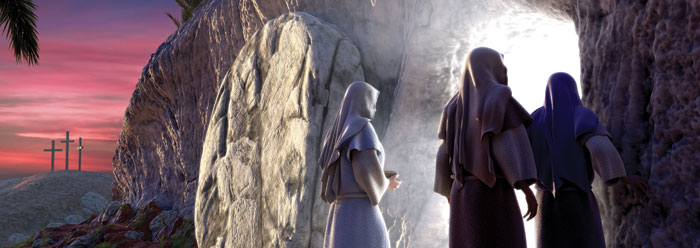
And behold, there was a great earthquake; for an angel of the Lord descended from heaven, and came and rolled back the stone from the door, and sat on it.  His countenance was like lightning, and his clothing as white as snow.  And the guards shook for fear of him, and became like dead men.
Now when the Sabbath was past, very early in the morning, on the first day of the week, Mary Magdalene, Mary the mother of James, and Salome bought spices, that they might come and anoint Him. And they said among themselves, “Who will roll away the stone from the door of the tomb for us?”  But when they looked up, they saw that the stone had been rolled away—for it was very large.
Then they went in and did not find the body of the Lord Jesus.  And it happened, as they were greatly perplexed about this, that behold, two men stood by them in shining garments.
Then, as they were afraid and bowed their faces to the earth. But he said to them, “Do not be alarmed. You seek Jesus of Nazareth, who was crucified. He is not here; for He is risen, as He said. Come, see the place where the Lord lay. Remember how He spoke to you when He was still in Galilee, saying, ‘The Son of Man must be delivered into the hands of sinful men, and be crucified, and the third day rise again.’ And they remembered His words. So they went out quickly from the tomb with fear and great joy, and ran to bring His disciples word.
Then they returned from the tomb and told all these things to the eleven and to all the rest.  It was Mary Magdalene, Joanna, Mary the mother of James, and the other women with them, who told these things to the apostles.  And their words seemed to them like idle tales, and they did not believe them.
Peter therefore went out, and the other disciple, and were going to the tomb.  So they both ran together, and the other disciple outran Peter and came to the tomb first.  And he, stooping down and looking in, saw the linen cloths lying there; yet he did not go in.  Then Simon Peter came, following him, and went into the tomb; and he saw the linen cloths lying there,  and the handkerchief that had been around His head, not lying with the linen cloths, but folded together in a place by itself.  Then the other disciple, who came to the tomb first, went in also; and he saw and believed.  For as yet they did not know the Scripture, that He must rise again from the dead.  Then the disciples went away again to their own homes.
But Mary stood outside by the tomb weeping, and as she wept she stooped down and looked into the tomb.  And she saw two angels in white sitting, one at the head and the other at the feet, where the body of Jesus had lain.  Then they said to her, “Woman, why are you weeping?”
She said to them, “Because they have taken away my Lord, and I do not know where they have laid Him.”
 Now when she had said this, she turned around and saw Jesus standing there, and did not know that it was Jesus.  Jesus said to her, “Woman, why are you weeping? Whom are you seeking?”
She, supposing Him to be the gardener, said to Him, “Sir, if You have carried Him away, tell me where You have laid Him, and I will take Him away.”
 Jesus said to her, “Mary!”
She turned and said to Him,“Rabboni!” (which is to say, Teacher).
 Jesus said to her, “Do not cling to Me, for I have not yet ascended to My Father; but go to My brethren and say to them, ‘I am ascending to My Father and your Father, and to My God and your God.’
 Mary Magdalene came and told the disciples that she had seen the Lord, and that He had spoken these things to her.
So they went out quickly from the tomb with fear and great joy, and ran to bring His disciples word.
 And as they went to tell His disciples, behold, Jesus met them, saying, “Rejoice!” So they came and held Him by the feet and worshiped Him.  Then Jesus said to them, “Do not be afraid. Go and tell My brethren to go to Galilee, and there they will see Me.”
 Now while they were going, behold, some of the guard came into the city and reported to the chief priests all the things that had happened.  When they had assembled with the elders and consulted together, they gave a large sum of money to the soldiers, saying, “Tell them, ‘His disciples came at night and stole Him away while we slept.’  And if this comes to the governor’s ears, we will appease him and make you secure.”  So they took the money and did as they were instructed; and this saying is commonly reported among the Jews until this day.


[1] Note: Much of the Harmony readings will be pieced together like a puzzle putting the four Gospels together into one narrative. I am copying the order or format from A Simplified Harmony of the Gospels, George W. Wright, Holman Bible Publishers, 2001. However, I am using the New King James rather than the HCSB. This order is from the research of Wright and is open to discussion. Of course, you can also read the passages side by side separately if you prefer.

Saturday, April 19, 2014

In the Tomb

John19:31-37; Matthew 27:57-66; Mark 15:42-47; Luke 23:50-56; John 19:38-42[1]


Therefore, because it was the Preparation Day, that the bodies should not remain on the cross on the Sabbath (for that Sabbath was a high day), the Jews asked Pilate that their legs might be broken, and that they might be taken away.  Then the soldiers came and broke the legs of the first and of the other who was crucified with Him.  But when they came to Jesus and saw that He was already dead, they did not break His legs.  But one of the soldiers pierced His side with a spear, and immediately blood and water came out.  And he who has seen has testified, and his testimony is true; and he knows that he is telling the truth, so that you may believe.  For these things were done that the Scripture should be fulfilled, “Not one of His bones shall be broken.”  And again another Scripture says, “They shall look on Him whom they pierced.”
Now when evening had come, because it was the Preparation Day, that is, the day before the Sabbath, Joseph of Arimathea, a prominent council member, a good and just man, who was himself waiting for the kingdom of God, who had not consented to their decision and deed, a disciple of Jesus—but secretly, for fear of the Jews—asked Pilate that he might take away the body of Jesus.
Pilate marveled that He was already dead; and summoning the centurion, he asked him if He had been dead for some time.  So when he found out from the centurion, he granted the body to Joseph. So he came and took the body of Jesus.
And Nicodemus, who at first came to Jesus by night, also came, bringing a mixture of myrrh and aloes, about a hundred pounds.  Then they took the body of Jesus, and bound it in strips of linen with the spices, as the custom of the Jews is to bury.  Now in the place where He was crucified there was a garden, and in the garden a new tomb in which no one had yet been laid. So there they laid Jesus, because of the Jews’ Preparation Day, for the tomb was nearby.
And Mary Magdalene and Mary the mother of Joses, and the women who had come with Him from Galilee followed after, and they observed the tomb and how His body was laid.  Then they returned and prepared spices and fragrant oils. And they rested on the Sabbath according to the commandment.
On the next day, which followed the Day of Preparation, the chief priests and Pharisees gathered together to Pilate, saying, “Sir, we remember, while He was still alive, how that deceiver said, ‘After three days I will rise.’  Therefore command that the tomb be made secure until the third day, lest His disciples come by night and steal Him away, and say to the people, ‘He has risen from the dead.’ So the last deception will be worse than the first.”
 Pilate said to them, “You have a guard; go your way, make it as secure as you know how.”  So they went and made the tomb secure, sealing the stone and setting the guard.


[1] Note: Much of the Harmony readings will be pieced together like a puzzle putting the four Gospels together into one narrative. I am copying the order or format from A Simplified Harmony of the Gospels, George W. Wright, Holman Bible Publishers, 2001. However, I am using the New King James rather than the HCSB. This order is from the research of Wright and is open to discussion. Of course, you can also read the passages side by side separately if you prefer.

Friday, April 18, 2014

At the Cross

Matthew 27:38-56; Mark 15:27-41; Luke 23:35-49; John 19:25-30[1]

And many women who followed Jesus from Galilee, ministering to Him, were there looking on from afar, among whom were Mary Magdalene, Mary the mother of James and Joses, and the mother of Zebedee’s sons. Now there stood by the cross of Jesus His mother, and His mother’s sister, Mary the wife of Clopas, and Mary Magdalene.  When Jesus therefore saw His mother, and the disciple whom He loved standing by, He said to His mother, “Woman, behold your son!”  Then He said to the disciple, “Behold your mother!” And from that hour that disciple took her to his own home.
And the people stood looking on. But even the rulers with them sneered, And those who passed by blasphemed Him, wagging their heads and saying, “Aha! You who destroy the temple and build it in three
days, save Yourself, and come down from the cross!”
Then someone ran and filled a sponge full of sour wine, put it on a reed, and offered it to Him to drink.
Likewise the chief priests also, mocking with the scribes and elders, said,  “He saved others; Himself He cannot save. If He is the King of Israel, let Him now come down from the cross, and we will believe Him. He trusted in God; let Him deliver Him now if He will have Him; for He said, ‘I am the Son of God.’
Then two robbers were crucified with Him, one on the right and another on the left. So the Scripture was fulfilled which says, “And He was numbered with the transgressors.” Then one of the criminals who were hanged blasphemed Him, saying, “If You are the Christ, save Yourself and us.”
But the other, answering, rebuked him, saying, “Do you not even fear God, seeing you are under the same condemnation?  And we indeed justly, for we receive the due reward of our deeds; but this Man has done nothing wrong.”  Then he said to Jesus, “Lord, remember me when You come into Your kingdom.”
And Jesus said to him, “Assuredly, I say to you, today you will be with Me in Paradise.”
Now from the sixth hour until the ninth hour there was darkness over all the land.  And about the ninth hour Jesus cried out with a loud voice, saying, “Eli, Eli, lama sabachthani?” that is, “My God, My God, why have You forsaken Me?”
 Some of those who stood there, when they heard that, said, “This Man is calling for Elijah!”  Immediately one of them ran and took a sponge, filled it with sour wine and put it on a reed, and offered it to Him to drink.
 The rest said, “Let Him alone; let us see if Elijah will come to save Him.”
 After this, Jesus, knowing that all things were now accomplished, that the Scripture might be fulfilled, said, “I thirst!”  Now a vessel full of sour wine was sitting there; and they filled a sponge with sour wine, put it on hyssop, and put it to His mouth.  So when Jesus had received the sour wine, He said, “It is finished!” And bowing His head, He gave up His spirit.
Then, behold, the veil of the temple was torn in two from top to bottom; and the earth quaked, and the rocks were split, and the graves were opened; and many bodies of the saints who had fallen asleep were raised; and coming out of the graves after His resurrection, they went into the holy city and appeared to many.
 So when the centurion and those with him, who were guarding Jesus, saw the earthquake and the things that had happened, they feared greatly, saying, “Truly this was the Son of God!”
And the whole crowd who came together to that sight, seeing what had been done, beat their breasts and returned.


[1] Note: Much of the Harmony readings will be pieced together like a puzzle putting the four Gospels together into one narrative. I am copying the order or format from A Simplified Harmony of the Gospels, George W. Wright, Holman Bible Publishers, 2001. However, I am using the New King James rather than the HCSB. This order is from the research of Wright and is open to discussion. Of course, you can also read the passages side by side separately if you prefer.

Thursday, April 17, 2014

Crucifixion

Matthew 27:27-37; Mark 15:16-26; Luke 23:26-34; John 19:17-24

Now as they led Him away, they laid hold of a certain man, Simon a Cyrenian, the father of Alexander and Rufus, and on him they laid the cross that he might bear it after Jesus. And a great multitude of the people followed Him, and women who also mourned and lamented Him.
But Jesus, turning to them, said, “Daughters of Jerusalem, do not weep for Me, but weep for yourselves and for your children.  For indeed the days are coming in which they will say, ‘Blessed are the barren, wombs that never bore, and breasts which never nursed!’  Then they will begin ‘to say to the mountains, “Fall on us!” and to the hills, “Cover us!” For if they do these things in the green wood, what will be done in the dry?”
And when they had come to the place called Calvary (the Place of a Skull, which is called in Hebrew, Golgotha), there they crucified Him. They gave Him sour wine mingled with gall to drink. But when He had tasted it, He would not drink.
Now it was the third hour [9:00 a.m.], and they crucified Him. Sitting down, they kept watch over Him there. Now Pilate wrote a title and put it on the cross. And the writing was:
JESUS OF NAZARETH, THE KING OF THE JEWS.
Therefore the chief priests of the Jews said to Pilate, “Do not write, ‘The King of the Jews,’ but, ‘He said, “I am the King of the Jews.”
 Pilate answered, “What I have written, I have written.”
 Then the soldiers, when they had crucified Jesus, took His garments and made four parts, to each soldier a part, and also the tunic. Now the tunic was without seam, woven from the top in one piece.  They said therefore among themselves, “Let us not tear it, but cast lots for it, whose it shall be,” that the Scripture might be fulfilled which says:
“They divided My garments among them,
And for My clothing they cast lots.”
Then Jesus said, “Father, forgive them, for they do not know what they do.”